A numerology arrow in a Vedic astrology grid shows a directional flow of energy between two points in your life chart, often revealing hidden strengths or challenges. These arrows connect planets, houses, and nakshatras to highlight focused patterns that shape your experiences.
What is a numerology arrow in Vedic astrology grids?
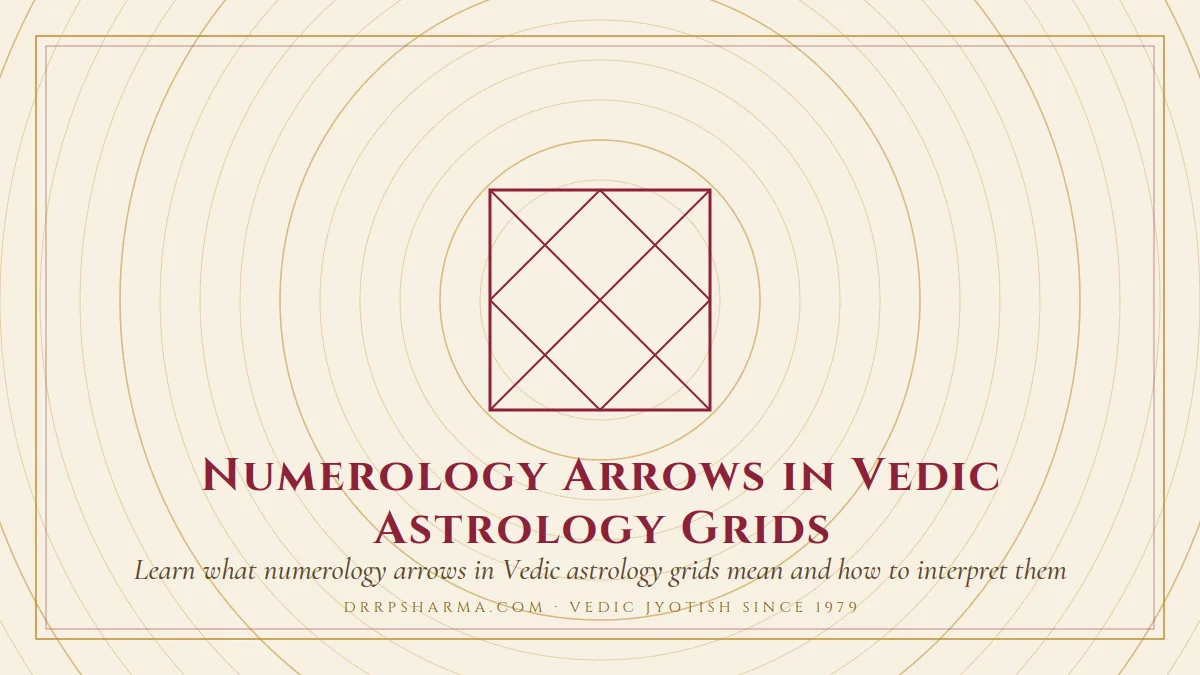
A numerology arrow is a diagonal line drawn between two points in a kundali grid, connecting a planet in one house to another planet or sensitive point in a different house. It acts like a bridge, showing where energy is concentrated and directed across the chart. The numbers in the grid (1 to 12) mark the houses and the arrow’s slope reveals whether the energy flows upward, downward, or diagonally.
In classical jyotish, these arrows are subtle pointers, not standalone yogas. They help you see how one area of life influences another, such as how your career house (10th) links to your marriage (7th) or health (6th). The direction and length of the arrow matter: upward arrows often indicate growth, while downward ones may signal delays.
How do numerology arrows form in a kundali?
They form when two sensitive points in the chart align diagonally in the grid layout. For example, if Saturn is in the 3rd house (Gemini) and Jupiter is in the 7th house (Sagittarius), a straight arrow connects them because 3 and 7 are opposite corners of a 12-house square. The calculation uses the house numbers only, not degrees, making it a simple geometric tool within the chart structure.
The presence of an arrow does not create a new yoga by itself, but it highlights an existing relationship between planets or houses. When strong planets like Mars or Jupiter are involved, the arrow’s effect becomes more noticeable in timing, especially during their dashas.
What do the direction and slope of the arrow mean?
Upward-sloping arrows (from lower to higher house numbers) generally indicate progress, new opportunities, or upward movement in life areas. Downward-sloping arrows may suggest delays, setbacks, or the need to work harder. Flat or horizontal arrows often reflect steady, consistent efforts without dramatic change.
A steep arrow (close to 45 degrees) shows strong intensity, while a gentle slope indicates a softer influence. For example, an arrow from the 2nd house (wealth) to the 11th house (gains) may reflect steady income growth, while one from the 6th (health) to the 12th (losses) suggests caution in spending on wellness.
Can numerology arrows change the strength of planets or dashas?
Yes, arrows can amplify or soften planetary influences depending on which houses and planets are connected. If a benefic planet like Jupiter sends an arrow to a malefic like Rahu, the arrow may reduce Rahu’s negative effects by redirecting its energy through Jupiter’s guidance. Conversely, a harsh arrow from Saturn to Mars can intensify obstacles in competitive or health matters.
During dashas, especially of planets involved in the arrow, their effects become more visible. If the dasha ruler is part of the arrow, events related to the connected houses are likely to manifest. This is why a chart reading that includes both dasha and arrows gives clearer timing guidance.
How can I identify numerology arrows in my own chart?
Look at your kundali drawn in the square grid format (12 houses arranged in a circle or square). Draw diagonal lines between any two planets or sensitive points (like Moon’s nakshatra degree or lagna). If the houses they occupy form a straight or gently curved diagonal, that’s an arrow. Use a ruler and check both directions—sometimes arrows work both ways.
You can do this by hand or using charting software that shows house positions clearly. Pay attention to planets in kendra (1, 4, 7, 10) and trikona (1, 5, 9) houses, as they form strong arrows more often. Keep your nakshatra and sign placements ready, as they refine the interpretation.
What practical steps should I take if an arrow points to a challenging area?
First, identify the planets and houses connected. If Saturn sends an arrow to the 8th house (debts or health), focus on disciplined saving, health checks, and avoiding risky decisions. Use the arrow to guide remedies: wear a blue sapphire if Saturn is strong, or light a sesame oil lamp on Saturdays near a peepal tree.
Practical timing also matters. If the arrow involves Mars and Rahu in the 3rd house (siblings), avoid confrontations during Mars’s dasha or Rahu’s antardasha. Cultivate patience and use the arrow as a compass, not a curse—every challenge in jyotish is a teacher in disguise.
Frequently Asked Questions
Do numerology arrows always indicate good or bad outcomes?
Numerology arrows are neutral tools that highlight where energy is focused. Whether the outcome feels good or challenging depends on the planets involved and the houses they connect. A Jupiter–Moon arrow to the 9th house generally brings wisdom and travel, while a Saturn–Ketu arrow to the 4th house may bring delays in home matters. The arrow simply shows the path; your actions determine the result.
Can two different arrows exist in one chart at the same time?
Yes, a single chart can show multiple arrows if several planetary pairs form diagonal connections. For example, if Mars in the 2nd house connects to Mercury in the 5th, and Jupiter in the 7th connects to Venus in the 10th, you have two distinct arrows pointing to financial creativity and marital harmony. Each arrow tells a separate story.
Should I rely only on numerology arrows for major life decisions?
No. Numerology arrows are one layer in the larger jyotish framework. They should be read alongside dashas, planetary strengths, ashtakavarga scores, and yogas like Gajakesari or Pancha Mahapurusha. For life-changing decisions such as marriage or career shifts, combine arrow analysis with muhurat selection and full chart review.
How do nakshatras influence the meaning of numerology arrows?
Nakshatras refine the arrow’s effect by adding emotional and behavioral context. For instance, if Saturn in Purva Phalguni (ruled by Venus) sends an arrow to the 7th house, the delay in marriage may relate to emotional hesitation or artistic pursuits. The nakshatra tells you the flavor of the delay, not just its presence.
Part of our guide: Career, Education & Life →
For guidance specific to your own birth chart, a personal consultation considers the complete picture.
Book a Consultation · ₹5,100 WhatsApp Dr. SharmaThis article is offered as general guidance in the Vedic tradition. Astrology is a tool for reflection and is not a substitute for professional medical, legal or financial advice.
Start free: your free kundli and 90-page PDF — no signup, no login, no ads. If you then want a personal reading, book a consultation (flat ₹5,100, by phone, WhatsApp or video).
See also: 2027 Grahan List In India.
Numerology: more in this series
Numerology Arrows of Strength · Numerology Arrows of Weakness Analysis · Numerology Basics: How Numbers Influence Life in the Vedic View · Numerology Birthday Insights for Your Life Path · Vedic Numerology Book for Deeper Insights · Numerology Certification Course · Numerology Courses for Serious Seekers · Numerology Grids and Vedic Astrology Charts · Mulank & Bhagyank calculator