The vastu purush mandala is the sacred 9x9 grid that underpins every home and building in Vedic tradition, mapping cosmic order onto earthly space. Knowing its presiding deities and their placements helps us live within natural harmony instead of against it.
What is vastu purush mandala and why does it matter in Vedic astrology?
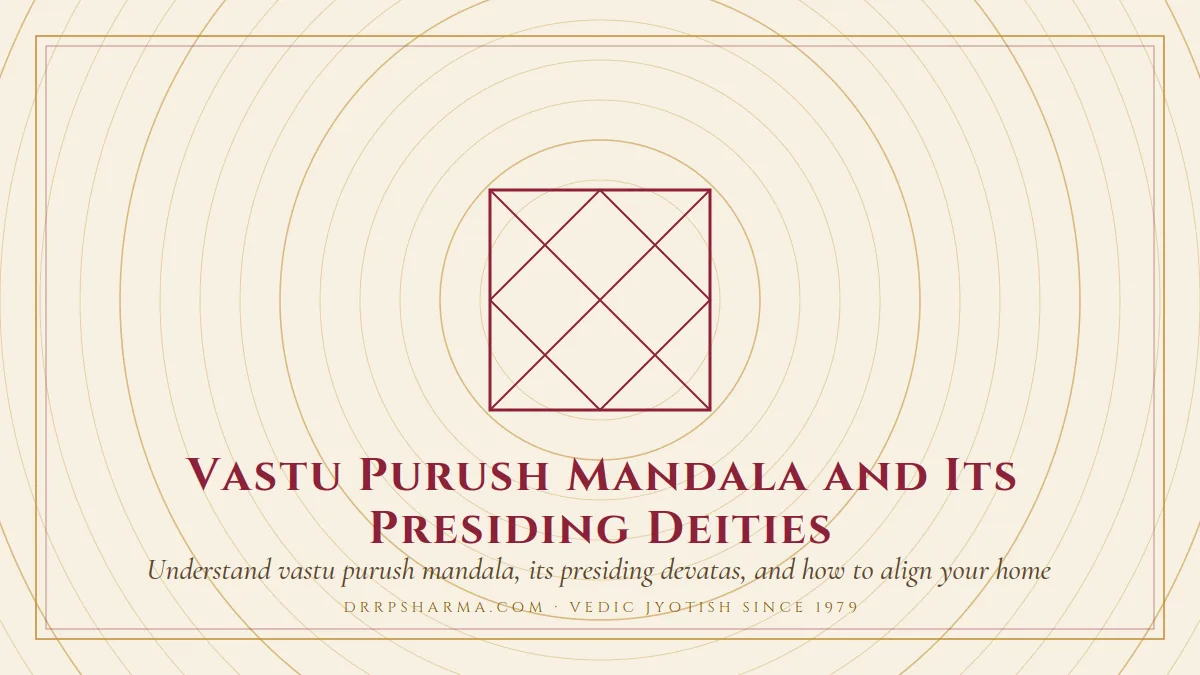
The vastu purush mandala is a 9×9 grid laid out at the foundation of every house or temple to represent the cosmic person, Vastu Purush, who lies bound beneath the structure. Each of the 81 smaller squares contains a specific devata (presiding deity) whose energy governs that zone of space. When doors, rooms and objects align with the right devata, the home supports health, wealth and peace; when misaligned, the resident feels blocked or restless without clear cause.
The central square, brahma sthana, belongs to Lord Brahma himself—symbolising the creative core of the dwelling. Around him sit thirty-one devatas in fixed order starting from the east corner (Indra, Agni, Yama, Nirriti, Varuna, Vayu, Kubera, Ishana) and continuing clockwise through each direction and sub-direction.
Which deities guard the eight primary directions in the mandala?
The eight corners of the 9×9 grid are guarded by the eight dikpālas, the guardians of space: Indra in the east, Agni in the southeast, Yama in the south, Nirriti in the southwest, Varuna in the west, Vayu in the northwest, Kubera in the north, and Ishana (a form of Shiva) in the northeast. Each dikpāla carries a specific energy—Indra brings vision and authority, Agni purifies, Yama governs time and justice, Nirriti dissolves negativity, Varuna fosters flow, Vayu brings movement, Kubera attracts wealth, and Ishana offers clarity and spiritual grace.
The dikpāla in the northeast, Ishana, is linked to the moon’s mental energy; keeping this zone open and light supports calm decision-making. In the southwest, Nirriti’s influence reminds us to clear clutter so old burdens do not weigh on the household.
How does the vastu purush mandala relate to the nine planets in Jyotish?
Each of the nine grahas rules one or more of the eight primary directions and the centre in the vastu mandala. The sun governs the centre, the moon rules the north-east, Mars the south, Mercury the north, Jupiter the north-east and east, Venus the south-east and north-west, Saturn the west and south-west, Rahu the south-west and north-west, and Ketu the south-east and south. When you place heavy furniture or open doors under a planet’s direction, its quality either strengthens or disturbs the residents’ life themes.
For example, placing the main door in the north-east under the moon increases mental clarity and learning capacity, while a door in the south under Mars can bring aggression or health heat if the room’s vastu is not balanced. A vastu consultant can review your layout against your Kundli’s dashas to see when remedies are most needed.
What are common vastu purush doshas and how do they show up in daily life?
A vastu purush dosha occurs when the building’s layout or openings sit over the wrong devata or cut through a forbidden zone, creating a subtle block in that devata’s domain. Signs include persistent arguments at home, unexplained fatigue, financial stagnation, or health issues that improve when you leave the house for a while. The dosha does not mean the house is cursed; it simply means the energies are not flowing as intended.
A common example is a kitchen located in the south-east under Venus, which can overheat the fire element and cause digestive stress or marital tension. Another is a main door facing south-west, placing the household under Nirriti’s heavy influence and inviting delays in work and lawful matters.
What practical steps bring a house into alignment with vastu purush mandala?
Start by checking the main entrance against the east or north-east under the moon or Jupiter; ensure it opens fully without obstructions and is well-lit. Place the master bed in the south-west under the earth element and the kitchen in the south-east under fire. Keep the centre of the house—Brahma sthana—clear of heavy objects so cosmic space can circulate. Use the appropriate colour and material for each zone: white and light for north-east, red and fire tones for south-east, blue and black for south-west, yellow and earth tones for south-west to west.
Small brass yantras of the relevant dikpāla can be installed at the prescribed location to strengthen the devata’s energy without altering the structure. Regular lightening of lamps before sunrise and sunset also honours the devatas and maintains positive prana.
Can vastu purush mandala remedies be applied during planetary periods (dashas)?
Yes, remedies work most effectively when timed with supportive dashas. For example, if Jupiter dasha is running and your main door faces north-east, installing a crystal or painting a gentle light there can amplify Jupiter’s gifts of wisdom and prosperity. Conversely, if Saturn dasha is strong and your south-west zone is weak, strengthening the earth element with salt lamps or heavy wooden furniture can steady the household.
Always review remedies in the context of your Kundli’s ascendant and moon sign. A remedy that suits a Libra ascendant may not fit a Leo ascendant, so personal chart timing matters as much as layout timing.
Frequently Asked Questions
Is it necessary to demolish a house if vastu purush dosha is found?
No. Demolition is rarely advised; most doshas can be corrected by rearranging furniture, adding colours, installing simple yantras, or placing mirrors and plants in the right zones. If the structure is unsafe, consult a qualified civil engineer first.
Can vastu purush mandala remedies work for rented homes or flats?
Yes. Renters can still place small copper or brass tablets of the relevant dikpāla in the prescribed direction, use colour-coded rugs, and keep the centre clear. Avoid drilling or permanent changes without landlord permission.
How do vastu purush and the nakshatras interact in home design?
Each dikpāla’s direction is linked to a nakshatra group; for example, the north-east belongs to the earthy Rohini and Mrigashira, so earthy colours and square shapes support that devata. The south-west belongs to the fiery Magha and Purva Phalguni, so red tones and rectangular forms strengthen it.
Can vastu purush mandala remedies replace medical or legal advice?
No. Vastu remedies are energetic adjustments; always consult qualified medical, legal or financial professionals for health, disputes or investments. Think of vastu as supportive atmosphere, not a substitute for expert care.
Part of our guide: Vastu Shastra →
For guidance specific to your own birth chart, a personal consultation considers the complete picture.
Book a Consultation · ₹5,100 WhatsApp Dr. SharmaThis article is offered as general guidance in the Vedic tradition. Astrology is a tool for reflection and is not a substitute for professional medical, legal or financial advice.
Dr. R.P. Sharma, Vedic astrologer since 1979; Ph.D. (Delhi University), M.A. Acharya in Predictive Astrology; author and teacher featured on Speaking Tree; 47,000+ YouTube subscribers.
Start free: your free kundli and 90-page PDF — no signup, no login, no ads. If you then want a personal reading, book a consultation (flat ₹5,100, by phone, WhatsApp or video).
See also: 2027 Grahan List In India.