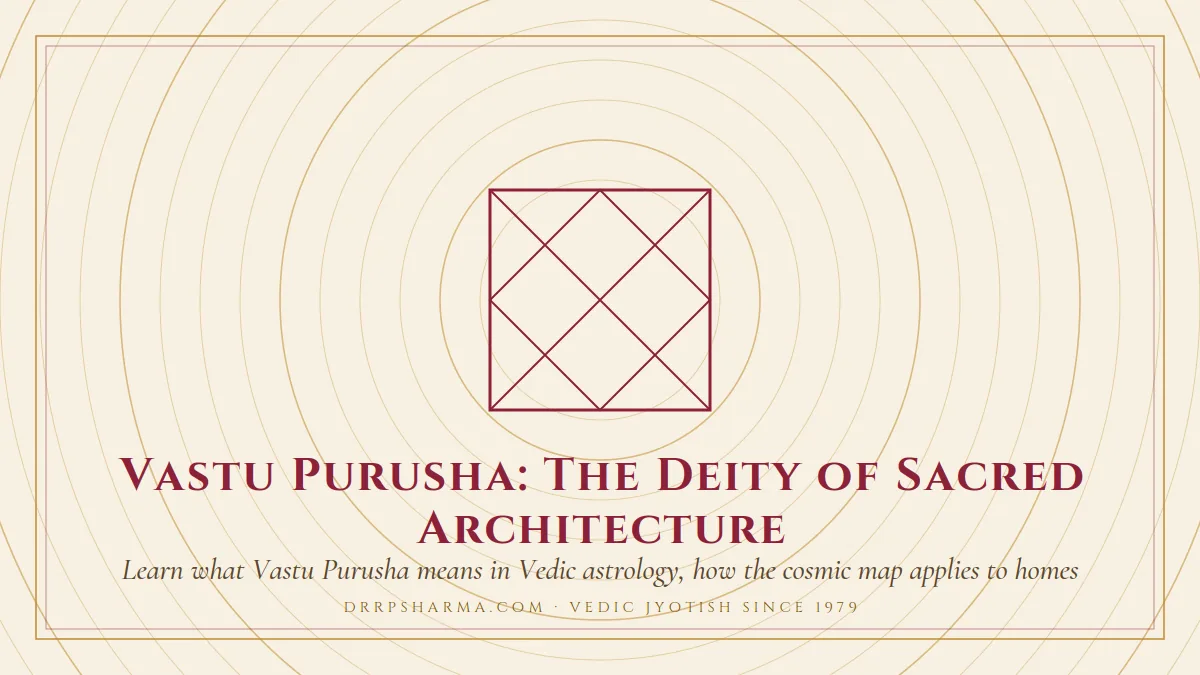
Vastu Purusha is the deity of the building site. In the traditional story he was pressed face-down onto the earth by the gods, who settled on his body — so every plot is pictured with his head in the north-east and his feet in the south-west. The Vastu Purusha Mandala, a grid of 64 or 81 squares, places Brahma at the centre (Brahmasthan) and 44 other deities around him; Vastu rules come from keeping each part of his body respected.
The story
Texts describe a being who grew so large that he blocked the sky. The gods held him down, face to the earth, and each settled on a part of his body; Brahma took the centre. Pleased by his submission, Brahma blessed him: whoever builds on the earth must honour him first. That is why a Vastu (bhoomi) puja precedes construction and a griha pravesh follows it.
The Vastu Purusha Mandala
- Grid: 64 squares (8 × 8, Manduka) for temples and rituals, or 81 squares (9 × 9, Paramashayika) for houses.
- Head: north-east — keep it light, open and clean; the puja corner belongs here.
- Feet: south-west — keep it heavy and closed; the master bedroom and storage belong here.
- Navel/centre: the Brahmasthan — keep it open, uncluttered and free of pillars, toilets or stairs.
- 45 deities: Brahma at the centre with 44 others around him, including the eight guardians of the directions.
| Zone | Element | Best use | Avoid |
|---|---|---|---|
| North-east (Ishanya) | Water | Puja, open space, underground water, study | Toilet, kitchen, heavy storage, staircase |
| East | — | Main door, windows, living room | Heavy walls blocking morning sun |
| South-east (Agneya) | Fire | Kitchen, electrical panel | Bedroom of young couples, water tank |
| South | — | Bedrooms, storage | Main door in the south-west part |
| South-west (Nairutya) | Earth | Master bedroom, heavy storage, overhead tank, locker | Toilet, underground water, main door, open pits |
| West | — | Children’s or guest bedroom, dining | — |
| North-west (Vayavya) | Air | Guest room, toilet, grain storage, garage | Master bedroom of the head of the family |
| North | — | Main door, cash area, living room | Heavy, high structures |
| Centre (Brahmasthan) | Space | Open, light, uncluttered | Pillars, toilets, staircases |
Honouring Vastu Purusha
- Bhoomi puja before laying the foundation, on a chosen muhurat.
- Vastu shanti or griha pravesh puja before moving in.
- Keeping the north-east clean and the centre open in daily life.
- Avoiding toilets, heavy loads or stairs over the centre and north-east.
Check your own home
Vastu is applied to a real floor plan with compass directions taken from the centre of the house. If you are unsure, a short online Vastu consultation works from your plan and photos — no structural change should be made without one.
Frequently asked questions
Who is Vastu Purusha?
The deity of the building site, pictured lying face-down with his head in the north-east and feet in the south-west.
What is the Vastu Purusha Mandala?
A grid of 64 or 81 squares with Brahma at the centre and 44 other deities around, used to plan buildings.
Why must the north-east be kept clean?
It is Vastu Purusha’s head and the zone of water and Jupiter, so it should stay light and open.
What is the Brahmasthan?
The central part of the mandala, assigned to Brahma; it should be open and uncluttered.
When is Vastu puja done?
Before construction (bhoomi puja) and before moving in (griha pravesh or vastu shanti).
Part of our guide: Vastu Shastra →
Want your own home or office checked? An online Vastu reading works from your floor plan, with simple corrections before any construction.
Book a Consultation · ₹5,100 WhatsApp Dr. SharmaThis article is offered as general guidance in the Vedic tradition. Astrology is a tool for reflection and is not a substitute for professional medical, legal or financial advice.
Start free: your free kundli and 90-page PDF — no signup, no login, no ads.